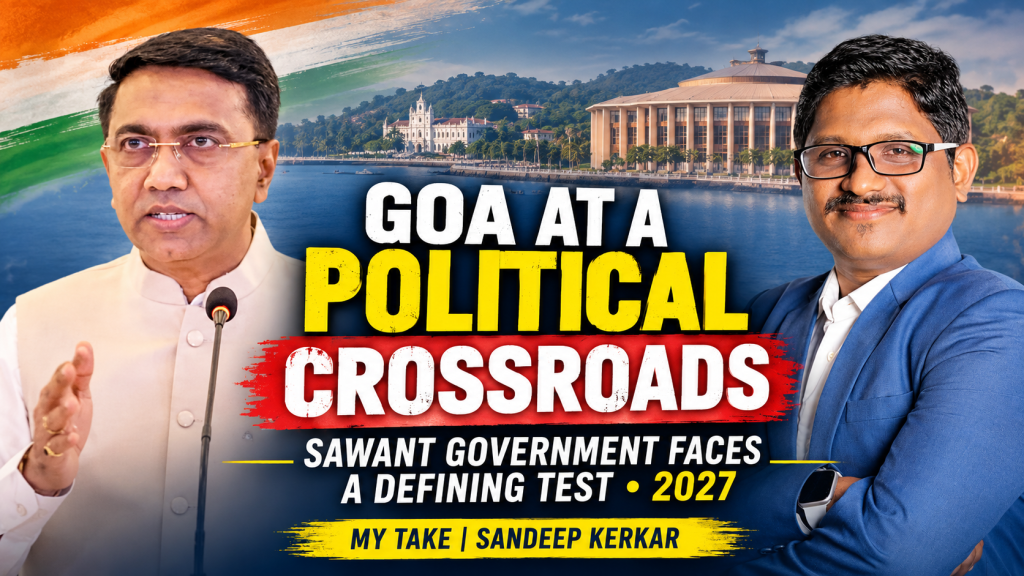
PANAJI: With barely a few months remaining before Goa heads into another Assembly election, the state’s political landscape is beginning to take a decisive shape. The ruling Bharatiya Janata Party (BJP), led by Chief Minister Dr Pramod Sawant, is preparing to defend its record, while opposition parties are attempting to build a credible political alternative. However, disagreements over alliances, the legacy of defections and competing political ambitions continue to complicate the opposition’s efforts.
The central political question in Goa is no longer simply which party can win the next election. It is whether the forthcoming contest will be fought primarily on governance and development, or whether political realignments, regional identity, public dissatisfaction and the fragmentation of opposition votes will dominate the campaign.
With the 2027 Assembly elections approaching, Goa is entering a politically significant period in which the performance of the incumbent government and the ability of opposition parties to present a coherent alternative will come under increasing public scrutiny.
BJP Government: Consolidation and the Challenge of Governance
Chief Minister Pramod Sawant’s government enters the final phase of its present term with the advantage of incumbency and an established organisational structure. The BJP continues to lead the state government with the support of the Maharashtrawadi Gomantak Party (MGP) and independent legislators.
The government is expected to place development initiatives, infrastructure expansion, welfare programmes, tourism promotion and investment on the centre stage of its election narrative.
However, the political assessment of any incumbent government extends beyond announcements and completed projects. Questions concerning implementation, employment generation, public services, environmental protection and the distribution of development benefits are likely to figure prominently in the coming months.
Goa’s development model remains a particularly important subject of public debate. The state must balance the economic importance of tourism and investment with the protection of its natural resources, traditional occupations, villages and distinctive cultural identity.
For the Sawant government, the challenge will be to demonstrate that development has translated into tangible improvements in the everyday lives of ordinary Goans.
Opposition Politics: Unity Remains the Biggest Question
The opposition’s principal challenge continues to be the absence of a settled and universally accepted alliance arrangement.
The Congress, which remains an established political force in Goa, is attempting to rebuild its organisational presence and regain political ground lost following the movement of several of its elected representatives to the BJP after the 2022 Assembly elections.
The Revolutionary Goans Party (RGP) has sought to strengthen its position through issues relating to Goan identity, land protection, local rights and governance. Its appeal has brought additional regional questions into the political debate.
Meanwhile, the Aam Aadmi Party (AAP), which secured two Assembly seats in 2022, is attempting to expand its political presence and position itself as an alternative to both the BJP and Congress.
The Goa Forward Party (GFP), led by Vijai Sardesai, continues to occupy an important position in the state’s regional political calculations.
The announcement of the Goa First alliance between AAP and GFP on September 13, 2026, initially suggested the emergence of a separate non-BJP and non-Congress political platform. However, disagreements soon surfaced over whether Congress should be included in a broader opposition arrangement.
By October, Sardesai had renewed his call for a wider opposition understanding, while AAP maintained its position against including Congress in the Goa First platform.
These developments illustrate the difficulty of bringing together parties that share an electoral objective but differ over political strategy, leadership and constituency-level interests.
The Congress and RGP have also explored an electoral understanding, although the precise arrangements, including seat-sharing, remain subject to further discussions.
Consequently, the opposition’s ability to resolve its differences and establish a coordinated electoral strategy remains one of the most important questions in Goa politics.
The Defection Issue and Public Trust
Political defections have become a recurring feature of Goa’s electoral history and remain a sensitive subject in public discourse.
The movement of eight Congress MLAs to the BJP in 2022 significantly altered the political composition of the state after voters had delivered their verdict.
For many voters, such developments raise fundamental questions about the relationship between an electoral mandate and the subsequent conduct of elected representatives.
The opposition has repeatedly used defections as an issue against the ruling establishment. The BJP, meanwhile, has the opportunity to defend its governance record and argue its case before the electorate.
Regardless of political affiliation, the larger democratic concern is the need to strengthen accountability and ensure that voters’ choices are respected.
In the coming election, the question of political stability and the credibility of elected representatives could become an important component of public debate.
Land, Environment and Goan Identity
Few issues are as closely connected to Goa’s political identity as land ownership, environmental conservation and the preservation of local communities.
The rapid transformation of parts of the state through construction, real estate development, tourism infrastructure and changing land-use patterns has generated debate among residents, civil society organisations and political parties.
The concerns extend beyond individual development projects. They involve the long-term character of villages, the availability of land for local residents, pressure on infrastructure and the protection of environmentally sensitive areas.
The Mhadei river dispute, mining, coastal regulation and the protection of forests and water resources also remain important matters in the state’s political conversation.
Political parties are likely to face questions about how they intend to reconcile economic development with environmental sustainability and the interests of future generations.
For a small state with limited land and ecological resources, these are not merely campaign subjects. They are fundamental questions about Goa’s development trajectory.
Employment, Tourism and the Economy
Employment opportunities, particularly for young people, will be another important test for the political establishment.
Tourism remains a major pillar of Goa’s economy, supporting businesses, hospitality services, transport operators, traders and thousands of families. However, the quality and sustainability of tourism growth, the availability of stable employment and the distribution of economic benefits remain subjects of discussion.
The challenge is to expand economic opportunities without allowing the state’s economy to become excessively dependent on a narrow range of activities.
Mining, agriculture, fisheries, small businesses, technology-based industries and entrepreneurship also deserve attention in any comprehensive development strategy.
Young Goans are likely to look beyond election promises and seek measurable improvements in employment, education, professional opportunities and the cost of living.
The political party that addresses these concerns through credible and implementable policies will have an opportunity to engage more meaningfully with the electorate.
A Changing Legislative and Political Landscape
Goa’s 40-member Legislative Assembly has also experienced changes during the present term.
Following the deaths of BJP legislators Ravi Naik and Jennifer Monserrate, two Assembly seats were vacant as of the latest reported legislative position in July 2026. The effective strength of the House had fallen to 38.
The BJP continued to receive support from its MGP partners and independent legislators, while the opposition benches included representatives of Congress, AAP, GFP and RGP.
The reduced strength of the Assembly and the political circumstances surrounding the vacancies form part of the broader context in which the state approaches the next election.
Meanwhile, election-related voter awareness preparations have begun. The South Goa District Election Office initiated programmes in October to familiarise voters and stakeholders with electronic voting machines and voter-verifiable paper audit trails ahead of the 2027 Assembly election.
This indicates that the electoral administration has begun preparations for the forthcoming democratic exercise.
The Road to 2027
As Goa moves towards the next Assembly election, the political contest is likely to revolve around three broad questions.
First, can the BJP-led government persuade voters that its development and governance record merits another term?
Second, can the Congress and other opposition parties overcome their differences and present a coordinated political alternative?
Third, will voters place greater emphasis on traditional political loyalties, regional identity, local constituency issues or the performance of the government?
These questions will acquire greater significance as parties finalise candidates, alliance arrangements and election manifestos.
Goa’s electoral history has repeatedly demonstrated that local issues and constituency-level political equations can play an important role in determining the outcome of state elections. National political narratives may influence the campaign, but the concerns of individual communities and constituencies cannot be overlooked.
The Verdict Will Ultimately Belong to the People
The political atmosphere in Goa is gradually becoming more competitive as parties prepare for the 2027 Assembly elections. The BJP has the responsibility of defending its record in government, while the opposition faces the task of demonstrating organisational unity, political credibility and a practical alternative.
For the electorate, the coming months offer an opportunity to examine the promises and performance of every political formation.
Issues such as employment, education, healthcare, infrastructure, land protection, environmental conservation, tourism management and the preservation of Goan identity deserve informed public discussion rather than being reduced to election-time slogans.
Ultimately, the future of Goa should not be determined solely by political alliances, party calculations or individual ambitions. It should be shaped by the quality of governance, the protection of public interests and the ability of elected representatives to remain accountable to the people who entrusted them with power.
As the state approaches another crucial electoral contest, one principle remains unchanged: political power may be contested by parties, but the final democratic mandate belongs to the people of Goa.





Leave a Reply